Federal Bodysnatchers and the New Guinea Virus by Robert S. Desowitz
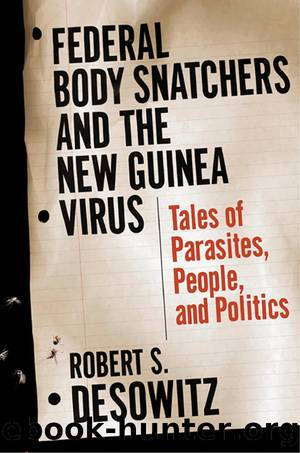
Author:Robert S. Desowitz
Language: eng
Format: epub
Publisher: W. W. Norton & Company
* Paracelsus had to contend with the prescriptions laid down 1,400 years earlier by that authoritarian Greek doctor, Galen. Galen had some peculiar ideas, although he did show that the arteries carried blood and not hot air. Galen did not recommend antimony or arsenic, and if he didn’t recommend it, then it wasn’t to be used. There is evidence that until the eighteenth, and perhaps early nineteenth century, the medical graduates of the University of Paris had to swear an oath never to use antimony and arsenic.
† Castellani was also an English knight, but that knight was different from all other knights because he became a Mussolini fascist, and the knighthood was rescinded. He then reverted to a mere Italian count again.
‡ Freud and Ehrlich looked somewhat alike and both were photographed smoking a cigar. Freud was reputed to have said, introspectively, that, “Sometimes a cigar is only a cigar,” but Ehrlich was the real chain-smoking stogie afficionado, twenty-five or more a day, a cigar box the constant companion under his arm.
§ The synthesis was three-quarters done by the great American chemist and Harvard professor Robert Burns Woodward and his colleague W. Doering in 1944. Complete synthesis of quinine was not accomplished until 2001, 150 years after Perkin’s first go at it. Gilbert Stork and his coworkers finally figured out the technique to make quinine “from scratch.” (See Steven M. Weinreb, “Synthetic Lessons from Quinine,” Nature, 24 May, 2001.) Also, there is a very readable account of Perkin’s life and work in Mauve by Simon Garfield (W. W. Norton, 2001).
¶ Methylene blue never achieved status as an antimalarial but curiously, the Nobelist pharmacologist-physiologist Sir Henry Dale in his introduction to a volume of Ehrlich’s collected papers notes that in the 1950s the Greek malariologist Dr. H. Foy told him that he still used it to treat quinine-resistant cases of malaria. Also, other workers kept at the methylene blue molecule and finally turned it into a yellow compound, atabrine, which was the prime antimalarial during World War II. Atabrine turned the skin a bright yellow and was dropped as an antimalarial drug. There is a fascinating new report that atabrine shows promise in treating human victims of Mad Cow disease.
#Trypanosoma brucei gambiense is something of a geographical misnomer. The range of the trypanosome extends well into central and east Africa. In the Congo, Sudan, and Uganda, it is endemic and epidemic.
** The man who inspired many of the youths of my generation, as kind of remote mentor, to pursue microbiology as an adult career was the bacteriologist Paul de Kruif. In his book Microbe Hunters, published in 1926, the lives and works of the scientists he wrote about were heroic. I was able to see the first edition held by the National Library of Medicine in Bethesda, Maryland, and was dismayed to find that the author-hero of my youth had feet of racist clay. Or just as disturbing, it reflected the callous racism of that era. He wrote, in his chapter
Download
This site does not store any files on its server. We only index and link to content provided by other sites. Please contact the content providers to delete copyright contents if any and email us, we'll remove relevant links or contents immediately.
| Anthropology | Archaeology |
| Philosophy | Politics & Government |
| Social Sciences | Sociology |
| Women's Studies |
Cecilia; Or, Memoirs of an Heiress — Volume 1 by Fanny Burney(32561)
The Great Music City by Andrea Baker(32021)
Cecilia; Or, Memoirs of an Heiress — Volume 2 by Fanny Burney(31958)
Cecilia; Or, Memoirs of an Heiress — Volume 3 by Fanny Burney(31944)
We're Going to Need More Wine by Gabrielle Union(19051)
All the Missing Girls by Megan Miranda(16045)
Pimp by Iceberg Slim(14519)
For the Love of Europe by Rick Steves(14159)
Bombshells: Glamour Girls of a Lifetime by Sullivan Steve(14080)
Talking to Strangers by Malcolm Gladwell(13375)
Norse Mythology by Gaiman Neil(13374)
Fifty Shades Freed by E L James(13245)
Mindhunter: Inside the FBI's Elite Serial Crime Unit by John E. Douglas & Mark Olshaker(9346)
Crazy Rich Asians by Kevin Kwan(9295)
The Lost Art of Listening by Michael P. Nichols(7507)
Enlightenment Now: The Case for Reason, Science, Humanism, and Progress by Steven Pinker(7315)
The Four Agreements by Don Miguel Ruiz(6767)
Bad Blood by John Carreyrou(6625)
Weapons of Math Destruction by Cathy O'Neil(6283)
